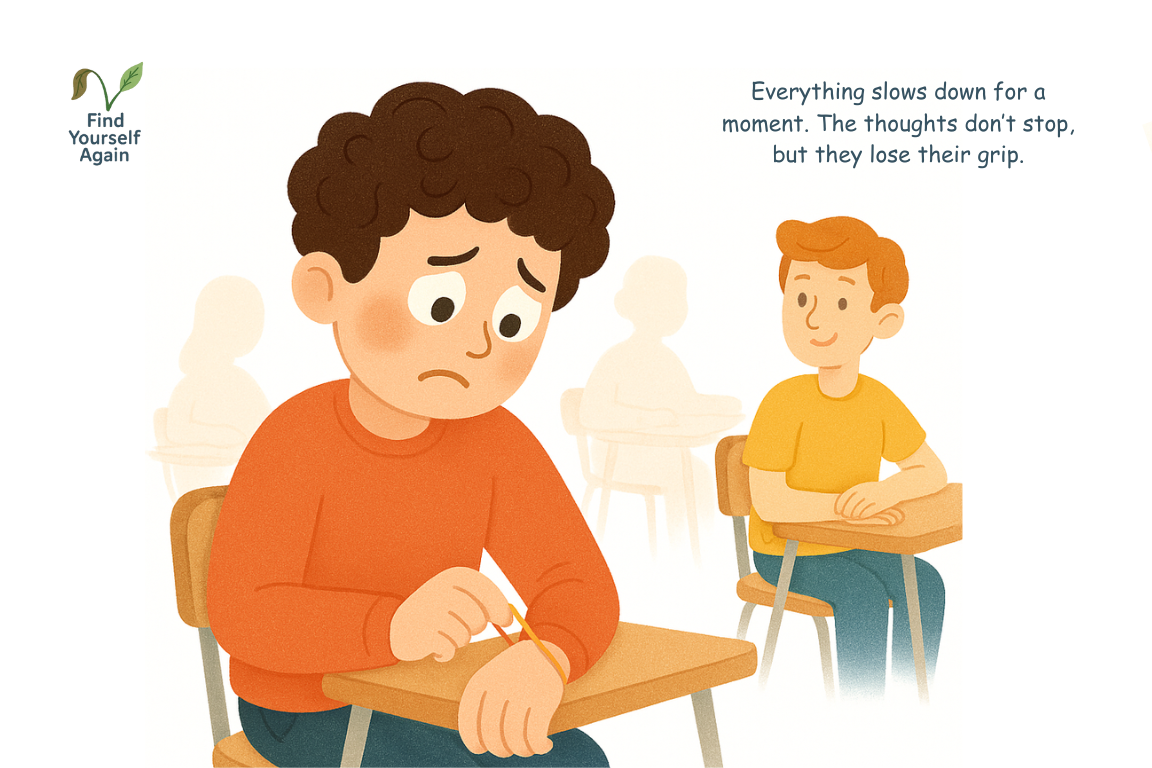
When anxiety starts to build, it rarely announces itself politely. It shows up as a wave of restlessness, a rush of heat, a sudden thought that something is wrong even when you know you are safe.
You try to reason with yourself, but your body doesn’t listen.
That is because anxiety begins in the body long before the mind catches up.
What you need in that moment is not another overcomplicated technique. You need something that interrupts the spiral and helps your body remember where it is.
This is where the rubber band trick comes in.
What the Rubber Band Trick Actually Is
It is simple. You wear a soft rubber band or a fabric hair tie around your wrist.
When you feel anxiety rising, you gently pull and release it. The light snap that follows is not meant to hurt. It is meant to bring you back.
That tiny moment of sensation tells your brain, “I’m here. This is real. I am safe.”
You are not using the band to punish yourself or to distract yourself. You are using it to create an instant connection between your thoughts and your body.
This technique is what psychologists call a pattern interrupt. It stops your nervous system from spiraling into automatic panic by giving it something neutral and physical to focus on.
Why This Simple Action Works
To understand why this helps, you need to know what happens during anxiety.
When your body senses threat, your brain floods your system with stress hormones like adrenaline and cortisol. Your heart beats faster. Your muscles tighten. Your thoughts become sharper and faster because your brain is preparing to protect you.
The problem is that your brain cannot always tell the difference between a real danger and an imagined one.
It reacts the same way whether you are running from a tiger or overthinking a text message.
The rubber band trick interrupts this automatic loop by using a quick, harmless sensory input. The mind pauses for a second. Your attention moves from your racing thoughts to the feeling on your wrist.
That pause is powerful. It gives your rational brain just enough time to step back in and calm the body down.
Here’s what’s happening on a deeper level:
1. It interrupts repetitive thinking
Anxiety thrives on repetition. The same thought loops over and over, making it feel stronger each time. A quick snap creates a moment of interruption, giving your brain space to reset.
2. It grounds you in the present moment
The physical sensation brings awareness to your body. Instead of being trapped in “what if” thoughts, you feel something real and immediate. That’s grounding.
3. It activates your parasympathetic nervous system
Once your body realizes there is no actual threat, your parasympathetic system, also known as the rest and digest mode, starts to calm your heartbeat and breathing. You begin to feel steadier.
4. It builds a safety association over time
When used gently and consistently, your brain begins to link the rubber band with a feeling of relief. The more you practice, the faster your body learns to relax when you touch or snap the band.
The rubber band trick works because it sends your body a different signal.
The light snap tells your nervous system that the threat is not real.
You are interrupting the automatic fight-or-flight loop and replacing it with a cue of safety.
In psychology, this is called grounding through sensory awareness.
You are using a physical cue to bring your focus back to the present moment.
How to Use the Rubber Band Trick Safely and Effectively
There are a few things to remember to make this work.
1. Choose the right band.
Pick a soft, flexible band that rests loosely around your wrist. Avoid anything too tight or harsh. It should never leave a mark or cause pain.
2. Set an intention before you need it.
Before you even feel anxious, decide what the band means for you.
You can say to yourself, “This is my reminder that I am safe.”
Or, “This helps me come back to the present when my thoughts run away.”
Setting that intention ahead of time tells your brain what the action represents.
3. Use it gently.
When anxiety starts, pull the band slightly and release it. Feel the soft sensation on your skin. Let that be your signal to pause. Then take a slow breath in through your nose and exhale gently through your mouth.
Say something grounding, like:
“I’m safe right now.”
“This is just a thought.”
“It’s okay to pause.”
4. Pair it with grounding.
Look around the room. Name three things you can see. Touch the fabric of your clothes. Feel your feet pressing into the floor.
This reinforces the message of safety and brings your attention fully into your surroundings.
5. Repeat when needed.
If the anxiety rises again, repeat the steps. With time, your brain starts linking the sensation of the rubber band with calm. The more you use it gently and consistently, the faster your body responds to it.
The Science Behind It
Your brain and body communicate constantly through a system called the vagus nerve. This nerve helps regulate your heart rate, breathing, and emotional responses.
When you engage your senses – by feeling a texture, hearing a sound, or noticing a physical sensation – you activate the calming side of this nerve, often referred to as the parasympathetic system.
That system is your body’s way of saying, “The danger has passed.”
The rubber band trick uses that same mechanism.
It gives your brain a momentary shift from racing thoughts to physical awareness, which starts to slow down the release of stress hormones.
This is why it works even when nothing else does. You are speaking to your nervous system in its own language – the language of sensation and safety.
What It Feels Like When It Begins to Work
At first, it might seem like nothing is changing. You might still feel anxious, but if you pay attention, you’ll notice something small: your thoughts slow down just enough for you to take a breath.
That’s progress.
Every time you create that space between thought and reaction, your nervous system learns that it doesn’t need to stay in alarm mode.
Eventually, you’ll find that just touching the band, or even thinking about it, can trigger that calming response. This is how self-regulation begins to build.
When to Be Careful
This method is meant to help you feel grounded, never punished. If you ever find yourself snapping the band too hard or using it out of frustration, stop and take a moment.
Anxiety is not something to fight against. It’s something to understand and regulate.
The goal is gentle awareness. The rubber band is simply a bridge between panic and calm, not a form of control.
How It Helps in Real Life
The rubber band trick works beautifully in situations where you can’t easily step away or use traditional relaxation techniques.
It can help when you are:
• Sitting through a long meeting or class
• Feeling anxious before a presentation or exam
• Standing in a crowded train or elevator
• Lying awake at night with racing thoughts
• Traveling or stuck in traffic
Because it’s silent and discreet, no one has to know you’re using it. That alone can bring comfort, especially if your anxiety shows up in public settings.
When to Try Other Tools
The rubber band technique is best for mild to moderate anxiety or to stop spiraling thoughts early. If you experience panic attacks that last several minutes, pair this with other grounding methods like slow breathing, muscle relaxation, or placing a cool cloth on your chest.
If anxiety feels constant or interferes with daily life, it’s okay to look for professional help. The goal is to create a full toolbox of techniques that help your nervous system regulate consistently.
The reason this tiny trick works isn’t magic – it’s science and self-awareness working together.
The rubber band acts as a bridge between your thoughts and your body. It gives you a chance to pause before anxiety decides what happens next.
It’s a reminder that even in moments when your mind feels out of control, there’s still something small you can do to steady yourself.
It won’t erase anxiety, but it helps you remember that you’re not powerless in it.
One small movement, one slow breath, and your brain starts to listen again.
That’s where calm begins – not from forcing yourself to relax, but from learning how to signal safety when everything feels loud inside.
Common Questions and Concerns
Is this self-harm?
No. When used gently, this is a grounding tool, not a punishment. The goal is not pain. It is awareness.
Does this replace therapy?
No. This is one of many tools you can use between sessions. It helps manage symptoms, but it doesn’t address the underlying causes of anxiety.
Can I use it anywhere?
Yes. It is discreet and silent. You can use it in class, during meetings, on a plane, or while sitting quietly at home. It looks like an ordinary band, so no one needs to know.
What if it doesn’t help right away?
That’s normal. Every nervous system learns at its own pace. The goal is consistency. The more you use it calmly, the better your body learns to respond to the signal.
Why This Matters So Much
Because anxiety makes people feel powerless.
It convinces you that you have no control over what your mind does.
But small tools like this remind you that you always have a way back.
It might not stop the thoughts immediately, but it gives you something your brain can’t argue with — a real, physical experience of safety.
That one moment can be the difference between spiraling and finding your ground.
For many people, this trick becomes more than a coping tool. It becomes a small act of self-trust. A reminder that they have what it takes to calm their own system, even when things feel unbearable.
Quick FAQ
Does it hurt?
Not at all. It should be gentle, never painful. Just enough to grab your brain’s attention.
Is this self-harm?
Absolutely not. When used correctly, this is a grounding technique, not a punishment.
Will others notice?
No. It’s incredibly subtle. A small flick of your wrist is usually unnoticed.
Final Thought: The Best Anxiety Tools Are the Ones You Actually Use
You don’t need to be perfect at calming yourself.
You don’t need 20 coping tools.
You just need one tool that works when it matters most – in the moment.
The rubber band trick may seem small, but it’s helped thousands of people regain a sense of control during their most anxious moments.
So try it.
Keep a rubber band on your wrist or in your pocket.
Let it remind you:
You’re not powerless. You’re not broken.
You’ve got tools – even if no one taught you before.
We often think anxiety needs big solutions. But the truth is – our brain responds best to small, real-world actions.
The rubber band trick gives you a sense of control, exactly when you feel like you’re losing it. Keep one on your wrist or in your pocket. Let it remind you: you’re not helpless. You’ve got tools.
Need more easy tools like this? I offer online therapy sessions that are gentle, practical, and focused on what works in the real world – not just theory.
📩 Book your session or DM me on Instagram. Let’s find what works for you.
