It starts quietly.
A tightness in your chest.
A buzz in your body that won’t stop.
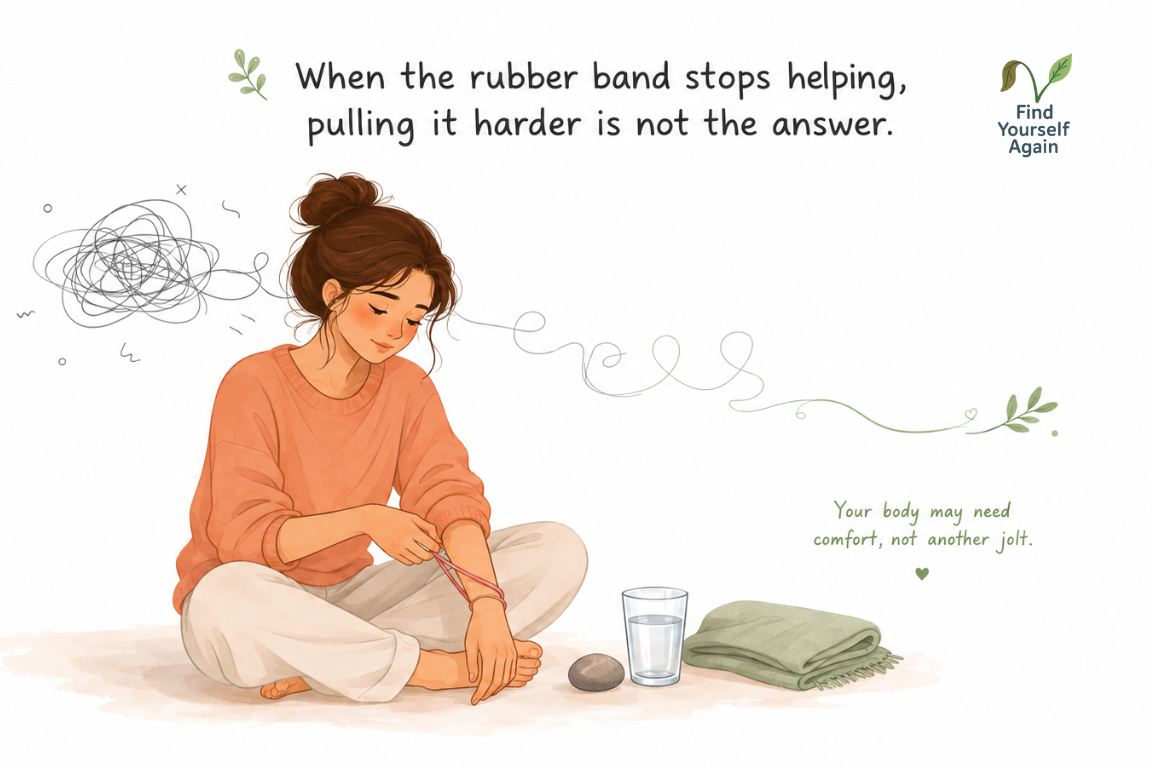
You reach for the rubber band on your wrist and snap it once, twice, three times. The sting bites for a second, but the uneasiness doesn’t leave. Your thoughts are racing, your breathing is shallow, and it feels like everything inside you is moving too fast.
You tell yourself to calm down. You pull the band again, harder this time. Still, nothing changes. The storm keeps growing.
You sit there wondering why the trick that used to help now feels useless. Why the snap that once grounded you barely makes a difference anymore.
If this moment feels familiar, you’re not broken. You’re human. And your body is trying to tell you something deeper.
The rubber band method is like a light switch. It flickers for a second, but it doesn’t fix the wiring underneath. What actually helps is learning how to calm the entire system gently and completely.
Let’s walk through that together.
Why the Rubber Band Trick Stops Helping
The rubber band trick works on distraction. It gives a quick physical jolt that cuts through racing thoughts. But over time, your brain stops reacting to that pain. The nervous system adjusts and says, “I know this feeling already.”
What happens next is that the focus moves from comfort to control. Instead of soothing your mind, you’re now trying to chase relief through repetition. The sting becomes another loop, another anxious action.
You don’t need to hurt to feel better. What you need is a way to teach your body calm.
That starts with tools that are simple, sensory, and kind.
The 30-Second Calm Fixes
When anxiety feels like a wave crashing too fast, these quick resets can help your body slow down.
1. Cold Water or Ice Trick
Take an ice cube, wrap it in a cloth, and place it gently on your wrists or neck. If you’re near a sink, splash cool water on your face. The sudden temperature change tells your body to pause and take a breath.
2. Box Breathing
Breathe in for four counts, hold for four, breathe out for four, hold for four.
Repeat four times.
It’s quiet, easy, and surprisingly effective when your thoughts start to spin.
3. The 5-4-3-2-1 Grounding Game
Look around. Find five things you can see, four you can touch, three you can hear, two you can smell, and one you can taste.
Make it a playful challenge instead of a chore. It helps your mind find the present moment again.
4. Humming
Hum softly. Feel the vibration in your chest. That gentle sound relaxes the vagus nerve, which signals safety to the brain.
5. Left-Right Tapping
Tap your left collarbone with your left hand, then your right collarbone with your right hand. Keep alternating for twenty seconds. This small rhythm balances the brain and body connection without drawing attention if you’re in public.
The Two-Minute Resets That Settle the Body
When you have a little more time, these grounding techniques go deeper.
6. Release the Tension Points
Tighten your jaw for five seconds, then let it go.
Lift your shoulders toward your ears and drop them.
Pull your belly in, hold, then release.
The more you relax your muscles, the more your mind starts to follow.
7. Name and Aim
Say out loud, “I feel anxious. My aim right now is comfort.” Then pick one small act of care — wrap a blanket, sip water, or step near a window. Naming the feeling gives your body direction instead of panic.
8. Grounded Walk
Stand up. Feel your feet. With each step, silently say heel, middle, toe. This reconnects you with stability when your mind feels scattered.
9. Sensory Anchor Kit
Keep a small kit close — a piece of mint gum, a smooth pebble, a scented tissue, a photo that makes you smile. When anxiety rises, pick one and focus on its texture, taste, or smell for a minute.
10. Thought Parking
When your brain won’t stop, write the worry on a small note: “Talk to boss at 7 PM.” Then set it aside. You’re giving your brain permission to rest.
The Five-Minute Routine That Teaches Calm
You can do this once or twice daily to train your body to feel safe again.
- Take three slow breaths, in for four and out for six.
- Roll your shoulders forward five times and back five times.
- Move your eyes gently from left to right, then up and down.
- Do one small task mindfully, like pouring tea or folding clothes.
- End with this line: This is hard, and I’m safe enough right now.
Small repetition builds emotional strength faster than effort or force.
When the Rubber Band Was Used to Stop Habits
If you used that band to break habits like nail biting or skin picking, there are better options.
11. Keep Your Hands Busy
Use a fidget ring, roll a small ball, or hold a smooth stone. Give your hands something neutral to do instead of turning to pain for control.
12. Replace the Trigger, Not the Habit
Ask yourself what comes before the habit. Is it boredom, tiredness, or harsh self-talk? Replace that moment with a new cue like stretching, sipping water, or standing up.
13. Ride the Urge
When you feel the urge, imagine it as a wave. Watch it rise, peak, and fall. Most urges pass within a minute if you stop fighting them.
Calming the Body First, Thoughts Later
When anxiety floods your body, trying to “think your way out” rarely works. First, help the body relax, and the mind will follow.
14. Two Mind Shifts That Help
Zoom Out Question: Will this still matter in three days, three weeks, or three months?
Label the Thought: Instead of saying “I’ll fail”, say “My mind is telling me the story that I’ll fail.”
You’re separating yourself from the thought instead of believing it completely.
Create Your Calm Map
Save this personal map on your phone for moments when everything feels too heavy.
Quick Rescues
Cold water on wrists
Box breathing
Humming
Left-right tapping
Mint gum
Short Resets
Shoulder rolls
Grounded walk
Sensory anchor
Comfort Items
Soft shawl
Photo of a happy memory
Smooth stone
Kind Reminder
“I can move through this one small step at a time.”
This becomes your go-to guide when words don’t help.
When Nothing Seems to Work
Some days, nothing works. That doesn’t mean you’re failing. It means your body is asking for extra gentleness.
- Check your basics. Have you eaten, had water, or stretched today?
- Lower the goal. Don’t chase complete calm. Aim for a small shift – even two percent less tension counts.
- Change your environment. Move rooms, open a window, or sit on the floor with your back against something solid.
- Borrow calm. Play soft music, a nature sound, or a slow breathing track. Let another rhythm lead you for a while.
And if anxiety has been stopping your sleep or your daily life, it’s always okay to reach out for help. Talking to someone doesn’t make you weak; it gives your healing a place to breathe.
Common Questions
Is the rubber band trick harmful?
Not necessarily, but it’s limited. It distracts for a moment; it doesn’t build calm.
How many techniques should I use?
Start with one quick rescue and one reset. Practice them daily for a week.
What if breathing makes me more anxious?
Skip breath counting. Try humming or tapping instead.
Can I use these tools in public?
Absolutely. They’re discreet and quiet. No one will notice.
How long before I feel better?
Some people feel relief right away. Others need a week or two of practice. It’s all progress.
