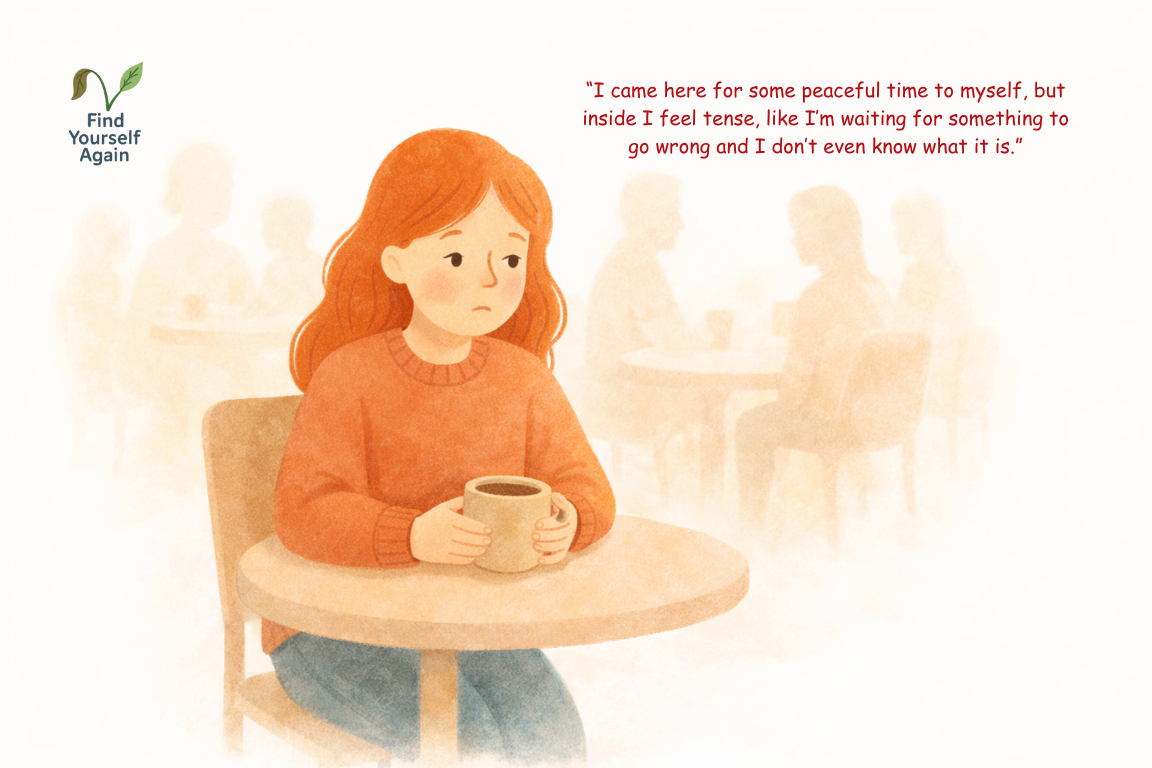
If you’re reading this because you think you might have anxiety, you’re probably not looking for a dictionary definition. You already know the common words: worry, fear, panic.
What you want to know is this:
Is what I’m feeling normal?
Is this anxiety?
Or is something wrong with me?
Anxiety, from the inside, doesn’t usually feel dramatic. It often feels subtle, constant, and deeply personal. It’s less like a loud alarm and more like a background tension that never fully switches off.
It Feels Like Your Body Is Bracing for Something
One of the clearest signs from the inside is a sense of “brace.”
You wake up and your chest already feels tight. Not painfully tight. Just enough to notice. Your breathing feels shallow, like you can’t quite get a satisfying full breath.
Nothing has happened yet. The day hasn’t even started. But your body feels like it’s preparing.
You might scan your mind for a reason:
Is it work? Did I forget something? Did I upset someone?
Sometimes there’s a clear stressor. Sometimes there isn’t. That’s what makes anxiety confusing. The body reacts before the mind can explain.
It Feels Physical – Even When the Problem Is Mental
Anxiety is not just thoughts. It lives in the body.
You might notice:
- A constant knot in your stomach
- A tight jaw or clenched teeth
- Shoulders that never fully relax
- Random waves of nausea before meetings or phone calls
- A racing heart during conversations that seem normal
- Feeling suddenly hot or flushed
If you’ve ever wondered, “Is this something medical?” you’re not alone. Anxiety can mimic physical illness because it activates the same stress systems designed to protect you.
To someone experiencing it, the sensations are real and sometimes frightening.
It Feels Like Your Mind Won’t Let Things Go
Anxiety thinking has a pattern. It doesn’t just stop at one concern.
You might replay a conversation over and over:
Why did I say that?
Did I sound stupid?
Did they notice I was nervous?
Even after someone reassures you, the doubt creeps back. Not because you enjoy worrying, but because your mind is trying to prevent future embarrassment or rejection.
It feels responsible in the moment. Like you’re being careful. But it’s exhausting.
The thoughts often focus on “what if” scenarios. What if this small mistake leads to something bigger? What if I fail? What if I disappoint someone important?
Your brain treats possibility like probability.
It Feels Like You’re Managing Yourself All the Time
Many people with anxiety look fine on the outside.
They work. They socialize. They function.
What isn’t visible is the internal management:
Monitoring your tone so you don’t sound awkward.
Planning what to say before speaking.
Checking emails multiple times before sending.
Mentally preparing for worst-case outcomes just in case.
It can feel like you’re always supervising yourself.
Even small tasks can feel heavier than they should because your mind adds layers of risk to them.
It Feels Hard to Relax Fully
Even in good moments, anxiety can linger.
You might be at dinner with friends but still feel slightly tense. You might be on vacation but unable to completely switch off. There’s often a low-level scanning happening in the background.
Is everything okay? Did I forget something? What’s next?
For someone experiencing anxiety, peace can feel temporary. The body stays slightly alert, as if it doesn’t trust calm to last.
It Feels Urgent
Waiting is one of the hardest parts of anxiety.
Waiting for a reply. Waiting for results. Waiting for feedback.
Your mind wants closure immediately. It pushes you to check again, ask again, research again. The behavior brings short relief, but it rarely lasts.
From the inside, anxiety feels like an urgency to solve something that cannot yet be solved.
It Feels Lonely
Because most of this happens internally, it can feel isolating.
You might look at others and think they seem relaxed, confident, unaffected. You compare your internal tension to their external calm.
What you don’t see is that many people are managing similar feelings quietly.
Anxiety often hides behind competence. That’s why it can feel like you’re the only one struggling.
Anxiety Is Not a Character Flaw
If you recognize yourself in this, it’s important to understand something.
Anxiety is not weakness. It’s not immaturity. It’s not a lack of strength.
At its core, anxiety is a protective response. Your system is trying to anticipate danger and prevent harm. The issue is not that it protects you – it’s that sometimes it protects you too aggressively.
It reacts to possibility as if it’s certainty.
From the inside, anxiety feels real because your body believes something important is at stake. Understanding that can shift the experience from self-criticism to self-awareness.
And awareness is often the first step toward feeling steadier.
